Why Do Lips Become Dry and Chapped During Seasonal Changes? Causes and Lip Care Tips for Kids




Baby Lotion vs. Kids Lotion: Is There a Difference?
Baby Lotion vs. Kids Lotion: Is There a Difference for Children Aged 5–12?
Parents often continue using the same body lotion as their child grows because it has been part of the family's routine for years. But once children enter the school-going years, their daily activities and skincare needs begin to change. They spend more time outdoors, wear uniforms for long hours, participate in sports, swim, sweat and experience frequent shifts between hot weather and air-conditioned environments.
This naturally raises an important question: should parents continue using baby lotion, or is it time to choose a body lotion created specifically for growing children?
There is no rule saying every child must stop using baby lotion at a particular age. However, a lotion formulated for children aged 5–12 may offer a texture, ingredient combination and everyday experience that better suits a growing child's routine. In this guide, we walk through the difference between baby lotion and kids skincare, when parents may consider switching, and how to choose gentle skincare for kids that actually fits their day.

🍼 Baby Lotion vs. Kids' Lotion: What Is the Difference?
At first glance, baby lotion and kids' lotion may look similar — both are designed to moisturise the skin and reduce uncomfortable dryness. The difference isn't simply that one is "mild" and the other is "strong." A well-formulated children's lotion should still be gentle. The main differences are usually found in the intended age group, texture, moisturising ingredients and the child's daily routine.
| Baby Lotion | Kids' Lotion |
|---|---|
| Developed for infants and very young children | Developed for growing children whose routines involve school, sports, swimming and uniforms |
| Simple moisturising formula | Effective everyday moisturisation for active days |
| Light or rich texture | Comfortable, non-greasy texture |
| Minimal or mild fragrance | Quick absorption before school or bedtime |
| Ingredients selected for very young skin | Support for dry-feeling elbows, knees and shins |
| Directions written for babies and toddlers | Clear age guidance for regular, everyday use |
Not every baby lotion is lightweight, fragrance-free or hypoallergenic — parents should always read the individual product label rather than relying only on the word "baby." Likewise, the goal of a kids' lotion isn't to be stronger. It's to be suitable for the practical needs of active, school-going children.
🌤️ How Children's Skincare Needs Change as They Grow
A child's skincare routine should develop alongside their lifestyle. Children aged 5–12 are generally more active and independent than they were during their early years, and their skin may be exposed to:
- Sweat and dust during outdoor play
- Friction from uniforms, socks and sports clothing
- Chlorinated water during swimming
- Frequent handwashing and bathing
- Hot weather and sun exposure
- Dry air from fans and air conditioning
- Seasonal changes during winter and summer
These factors can leave the skin feeling dry, rough or tight — particularly around the arms, legs, knees, elbows and shins. A children's body lotion should provide enough moisturisation to keep the skin comfortable while still absorbing quickly enough for everyday routines.
🤔 Does Every Child Need to Switch from Baby Lotion?
Not necessarily. When the existing lotion keeps the child's skin comfortable, is suitable for their age and does not cause irritation, there may be no immediate reason to stop using it. The decision should be based on how the child's skin feels and how comfortably the product fits into everyday life — not simply on reaching a particular birthday.
🚦 Signs It May Be Time to Choose a Kids' Body Lotion
1
The Skin Feels Dry Again Soon After Application
When arms or legs feel dry only a few hours after moisturising, the current lotion may not be providing enough lasting comfort. A balanced combination of moisturising ingredients may suit them better.
2
Rough-Feeling Elbows, Knees or Shins
Uniforms, socks, sports and everyday movement create repeated friction. Regular lotion application to these areas can help keep the skin feeling softer and smoother.
3
The Existing Lotion Feels Too Sticky
Children may avoid moisturising when a lotion feels heavy or oily. A lightweight, fast-absorbing texture makes the routine easier before school, playtime or bedtime.
4
The Child Spends More Time Outdoors
Outdoor play exposes skin to sweat, dust, wind and repeated washing. A suitable lotion helps restore moisture — though it does not replace sunscreen unless specifically labelled and tested for sun protection.
5
Seasonal Changes Make the Skin Feel Dry
Some children need more frequent moisturisation during winter, while others experience dryness from summer heat, swimming or air conditioning. Adjust the amount and frequency by season.
6
The Child Is Becoming Independent
Children aged 5–12 can gradually learn to apply lotion to their own arms and legs. A product that spreads easily and absorbs quickly encourages them to take part in their own routine.
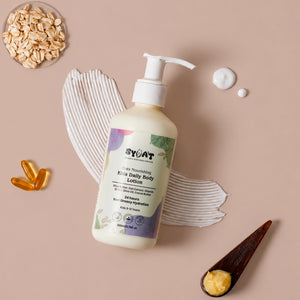
There is no medically fixed age at which every child must stop using baby lotion. For children entering the school-going years, parents can begin evaluating whether the current product still provides the right level of moisturisation and comfort. Syoat Kids Body Lotion is formulated specifically for children aged 5–12, making it suitable for parents ready to move from a baby-focused product to age-appropriate kids skincare.
🔍 How to Choose the Best Body Lotion for Kids
| What to Check | Why It Matters |
|---|---|
| Recommended age group | Choose a product aligned with your child's stage of growth rather than depending on general marketing language. |
| Effective moisturising ingredients | A children's body lotion should help maintain moisture and soften dry-feeling skin — effectiveness depends on the full formulation, not one "hero" ingredient. |
| Comfortable texture | Look for a product that spreads easily, absorbs quickly and doesn't leave excessive stickiness beneath clothing. |
| Clear, responsible claims | "Dermatologically tested" and "pH-balanced" are useful signals, but always patch-test a new product before wider use. |
| A formula that fits your child | Review the full ingredient list rather than assuming an unfamiliar name is harmful — choose a properly formulated product from a trusted manufacturer. |
| Fragrance sensitivity | Fragrance preferences vary child to child. Patch-test carefully if your child has reacted to fragranced skincare before. |
| Separate sunscreen for outdoor play | A regular body lotion should not be expected to provide sun protection unless it clearly carries a tested SPF rating. |
🌾Oats ExtractSoothes dry-feeling skin
💧Vitamin B5Supports hydration
✨Vitamin ENourishing, healthy-looking skin
🧈Shea ButterSoftens rough areas
🍫Cocoa ButterKeeps skin smooth & supple
Why Choose Syoat Kids Body Lotion?
Created for active, school-going children aged 5–12 with Oats Extract, Vitamin B5, Vitamin E, Shea Butter and Cocoa Butter. Lightweight and fast-absorbing, dermatologically tested and pH-balanced — paraben-free, silicone-free and mineral-oil-free.
Shop Now💧 How to Use Body Lotion for the Best Results
1
Apply After Bathing
Gently pat the skin dry and apply lotion while it is still slightly damp. This helps retain moisture and reduces the dry or tight feeling that may occur after bathing.
2
Focus on Dry Areas
Pay particular attention to elbows, knees, shins, arms, legs and hands — these areas may need a little more product because of repeated washing, friction or outdoor activity.
3
Reapply When Required
The lotion can be reapplied to dry-feeling areas after school, swimming or outdoor play. Small, targeted applications are often more comfortable than one heavy layer a day.
4
Encourage Independent Use
School-going children can gradually learn to apply lotion to their own arms and legs — turning moisturising into a simple after-bath habit builds everyday personal care.
❓ Frequently Asked Questions
Can my child continue using baby lotion after the age of five?
Yes, provided the product is suitable for your child, keeps the skin comfortable and does not cause irritation. However, a kids-specific lotion may provide a texture and moisturising experience better suited to school, outdoor play and growing independence.
Is kids' lotion stronger than baby lotion?
Not necessarily. A properly formulated kids' lotion should remain gentle. The difference is usually in the intended age group, texture, moisturising ingredients and suitability for a growing child's routine.
Does my child need a rich, heavy lotion?
Not always. The best texture depends on the child's skin and climate. Many school-going children prefer a lightweight lotion during the day because it absorbs quickly and feels comfortable beneath clothing. Dryer areas can be given a small additional application when required.
Can body lotion replace sunscreen?
No. Unless the lotion is specifically labelled with tested SPF protection, it should not be used as a substitute for sunscreen. Use an age-appropriate sunscreen, hats, shade and protective clothing during outdoor activities.
Is Syoat Kids Body Lotion suitable for everyday use?
Yes. It is formulated for regular moisturisation and can be applied after bathing, before bedtime or whenever the skin feels dry.
Is Syoat Kids Body Lotion a treatment for eczema or rashes?
No. Syoat Kids Body Lotion is a cosmetic moisturising product. It is not intended to diagnose, treat or cure eczema, rashes or other medical skin conditions. Consult a paediatrician or dermatologist when a child has persistent itching, redness, broken skin, recurring rashes or a diagnosed skin condition.
There is no universal deadline for stopping baby lotion. The better question is whether the current product still suits your child's age, skin and everyday routine. As children enter the 5–12-year stage, a kids-specific body lotion can provide the moisturisation they need in a lightweight, practical format that fits comfortably into their day — simple, consistent kids skincare rather than a complicated routine.
Gentle Skincare for Kids, Made for Growing Days
Syoat Kids Body Lotion combines Oats Extract, Vitamins B5 and E, Shea Butter and Cocoa Butter to keep dry-feeling skin soft, smooth and comfortable — without a heavy or greasy feel.
Dermatologically Tested
pH-Balanced
Paraben Free
Mineral-Oil Free